Hazard symbols can prevent injuries only when people understand and follow them.
For example, chemicals often carry red-diamond GHS pictograms. Meanwhile, workplaces use yellow triangles, blue circles, and other standard safety signs.
Therefore, workers must identify the system before taking action. This guide explains common hazard symbols and warning labels in Singapore workplaces.
What do hazard symbols and warning labels mean?
Hazard symbols show the type of harm that a substance, activity, or location may cause. Warning labels add words and instructions that help people avoid that harm.
In short, these visual messages answer four questions:
- What is the hazard?
- How serious is it?
- What action must I take?
- Where can I find more information?
However, a symbol never replaces a risk assessment, safe work procedure, or training. Instead, it provides a fast warning at the point of danger.
Nine GHS hazard symbols and their meanings
The Globally Harmonised System, or GHS, communicates chemical hazards through labels and Safety Data Sheets. Singapore applies GHS requirements through the SS 586 series.
Moreover, an
MOM circular confirms that revised Parts 2 and 3 took effect on 6 February 2025.
GHS pictograms feature a black image on a white background inside a red diamond. Each pictogram communicates a hazard group.
| GHS hazard symbol | Meaning | Hazards it may indicate |
|---|
| Exploding bomb | Explosion or violent reaction | Explosives, certain self-reactive chemicals, and organic peroxides |
| Flame | Fire hazard | Flammable, pyrophoric, self-heating, or self-reactive substances |
| Flame over circle | Oxidising hazard | Chemicals that can cause or intensify a fire |
| Gas cylinder | Gas under pressure | Compressed, liquefied, dissolved, or refrigerated gases |
| Corrosion | Corrosive harm | Severe skin burns, eye damage, or corrosion of metals |
| Skull and crossbones | Severe acute toxicity | Chemicals that can quickly cause poisoning or death |
| Exclamation mark | Harmful or irritating effects | Irritation, skin sensitisation, drowsiness, or harmful acute toxicity |
| Health hazard | Serious or long-term health effects | Cancer, organ damage, reproductive harm, or respiratory sensitisation |
| Environment | Aquatic environmental harm | Acute or long-term toxicity to aquatic life |
Importantly, one chemical may display several pictograms. Therefore, never use one symbol to guess the product’s complete risk profile.
Consequently, users must read every label element and consult the SDS.
The WSH Council’s GHS guide explains Singapore’s labelling approach and workplace duties.
How to read a chemical warning label
A GHS pictogram gives only a quick hazard overview. Therefore, read the complete chemical label before opening, moving, mixing, or disposing of the product.
1. Check the product identifier
First, confirm the product name. Never identify an unknown chemical through colour, smell, taste, or container shape.
2. Read the signal word
Next, look for Danger or Warning. “Danger” marks more severe hazard categories, while “Warning” marks less severe categories.
Nevertheless, both words demand attention. Neither word suggests that careless handling is acceptable.
3. Review every pictogram
Then, identify each hazard group. A product may present physical, health, and environmental hazards at the same time.
4. Follow the hazard statements
Hazard statements describe the specific harm. For example, they may warn about flammable vapour, serious eye damage, or respiratory irritation.
5. Follow the precautionary statements
Precautionary statements explain prevention, response, storage, and disposal. Accordingly, follow their instructions together with the SDS and workplace procedures.
6. Check supplier information
Finally, confirm the supplier details and emergency contact information. Also, ensure that the product matches the label and SDS.
According to the WSH Council, a full label contains the product name, pictograms, signal word, hazard and precautionary statements, supplementary details, and supplier information.
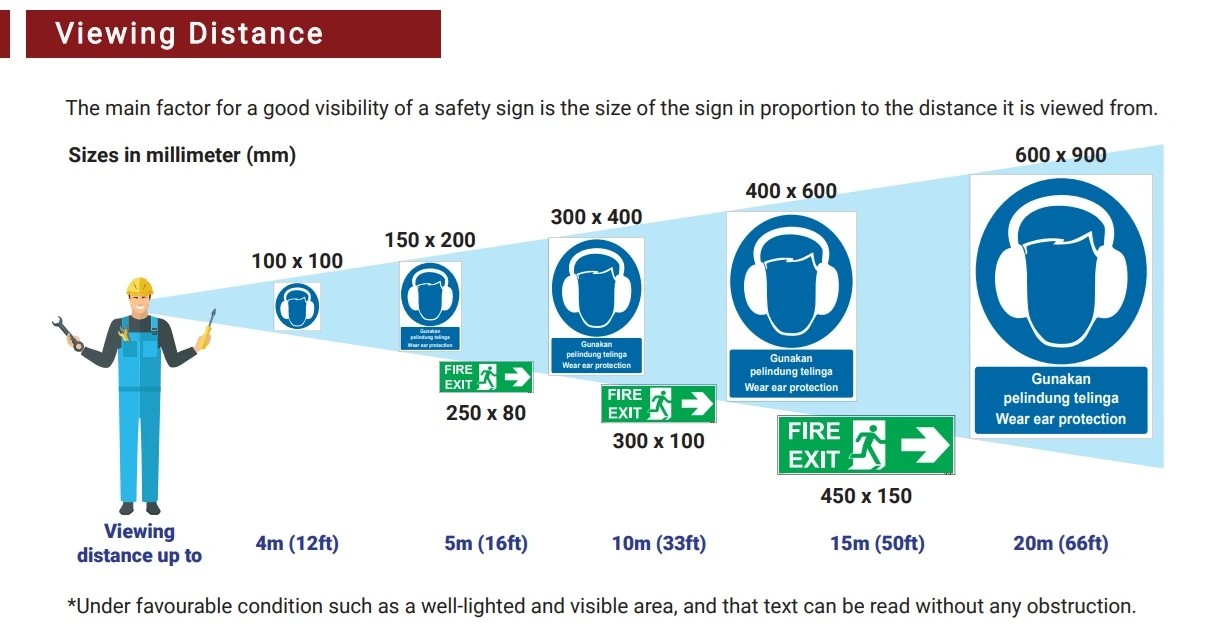
What do workplace safety-sign colours mean?
Workplace signs use colour, shape, symbols, and words to communicate an instruction. Therefore, workers should never rely on colour alone.
| Safety-sign category | Typical colour and shape | Meaning | Common examples |
|---|
| Prohibition | Red circle with a diagonal bar | You must not perform the displayed action | No smoking, no entry, no open flames |
| Warning | Yellow triangle with a black border | A hazard exists; proceed carefully | Electrical hazard, toxic material, slippery surface |
| Mandatory action | Blue circle with a white symbol | You must perform the displayed action | Wear eye protection, safety helmet, gloves, or safety footwear |
| Safe condition | Green square or rectangle | Shows safety facilities or a safe route | Emergency exit, first aid, assembly point |
| Fire equipment | Red square or rectangle | Identifies fire alarms or firefighting equipment | Fire extinguisher, hose reel, fire alarm |
For example, a blue circle showing goggles means wear eye protection. Conversely, a red circle across a cigarette means no smoking.
Singapore’s WSH guidance groups signs into these categories and references SS 508. However, signs do not replace training or onsite controls.
Chemical labels and transport placards are different
GHS labels support chemical supply and workplace use. In contrast, numbered dangerous-goods placards help transport workers and emergency responders identify transport hazards.
Singapore workplace duties for warning labels
Singapore’s Workplace Safety and Health framework places clear duties on workplace occupiers. In particular, regulations 41 to 43 address hazardous substances, warning labels, and Safety Data Sheets.
Under regulation 42, occupiers must ensure that hazardous-substance containers carry suitable warning labels, as far as reasonably practicable. Workers must understand the hazard and precaution information.
Additionally, regulation 41 requires warning notices at workroom entrances and suitable locations. Occupiers must also warn exposed people about hazards and precautions.
Furthermore, regulation 43 requires occupiers to obtain and assess the SDS. They must also make it available to people who may face exposure.
The
WSH (General Provisions) Regulations provide the complete wording and relevant exclusions. Consequently, businesses should seek competent advice whenever the regulatory scope remains unclear.
What should workers do when they see a hazard symbol?
First, stop and identify the sign system. Next, read the complete label or nearby instruction.
Then, check the SDS and safe work procedure. Afterward, apply the required ventilation, isolation, handling, and PPE controls.
However, do not continue when a container lacks identification. Instead, isolate it safely and report it to the supervisor or responsible person.
Likewise, never smell or taste an unknown substance. Never mix chemicals to test their identity.
During a spill, leak, fire, or exposure, follow the site emergency plan. Moreover, alert trained responders and keep unprotected people away.
Warning-label checklist for employers
Use this checklist during workplace inspections:
- [ ] Every hazardous chemical container has a clear, current, and legible label.
- [ ] The product identifier matches the current SDS.
- [ ] Workers understand the symbols, language, and precautions.
- [ ] Decanted chemicals receive suitable workplace labels.
- [ ] Hazard notices appear at relevant entrances and work areas.
- [ ] Workers receive training on labels, controls, PPE, and emergencies.
- [ ] Supervisors replace damaged, faded, or outdated signs promptly.
Contact our sales team for customised signage solutions
Contact our sales team to discuss your site hazards, design requirements, quantities, and preferred materials.
Frequently asked questions
Common symbols include the flame, corrosion, skull, exclamation mark, gas cylinder, and health-hazard pictograms. Additionally, workplaces often display PPE and electrical-warning signs.
A yellow triangle warns that a hazard exists. For example, it may identify electricity, toxic materials, slippery floors, or overhead loads.
A blue circle gives a mandatory instruction. Therefore, workers must follow actions such as wearing eye, hearing, hand, foot, or head protection.
“Danger” identifies more severe hazard categories. In comparison, “Warning” identifies less severe categories, although both require proper precautions.
No. Instead, the label shows pictograms that match the chemical’s classification. Some products show one symbol, while others show several.
No. A label provides immediate container information. Meanwhile, the SDS gives detailed guidance about handling, storage, exposure controls, emergencies, disposal, and transport.
Make every safety message easy to understand
Ultimately, effective hazard communication connects accurate labels, visible signs, trained people, and reliable controls.
Safetyware supplies safety signs, chemical labels, and workplace safety equipment in Singapore. Moreover, we offer customised signage solutions for specific hazards, instructions, languages, sizes, and site conditions.
Important: This article provides general information, not legal or site-specific safety advice. Always check current legislation, SS 586, SS 508, the SDS, and competent professional guidance.