Food industry workers face more than hygiene risks. Wet floors, sharp knives, hot liquids, cleaning chemicals, cold rooms, loud machinery and moving equipment can all cause injury. At the same time, unsuitable or poorly managed protective wear can contaminate the food it is meant to protect.
For businesses in Singapore, the right approach is not to issue the same PPE to everyone. It is to identify the hazards in each task, control those hazards at source and then select suitable personal protective equipment (PPE) for the risks that remain.
What PPE is needed in the food industry?
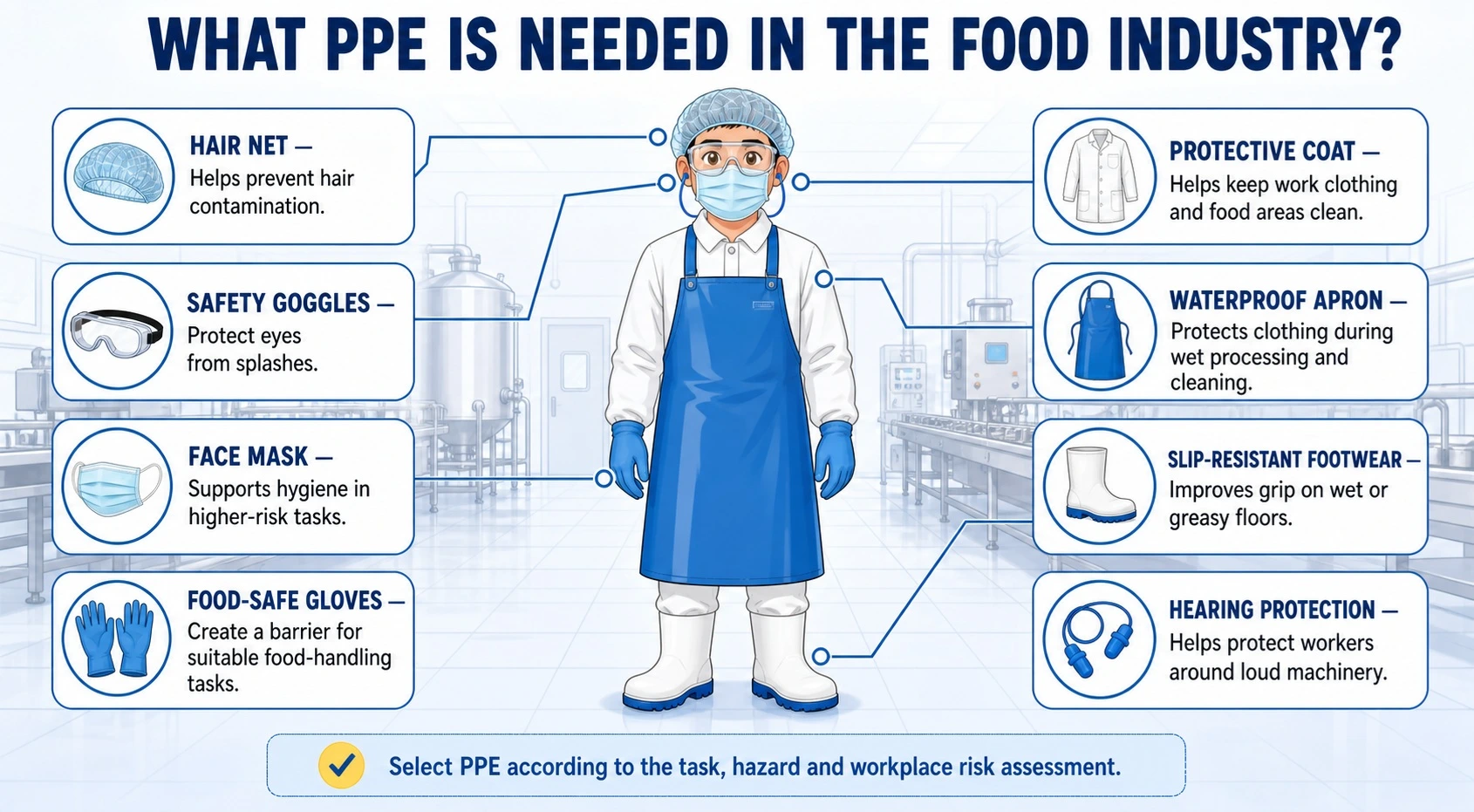
Common PPE and hygiene wear in food processing, commercial kitchens, central kitchens and food storage facilities includes:
- Food-safe disposable, chemical-resistant, thermal or cut-resistant gloves
- Slip-resistant safety shoes or boots
- Aprons, sleeve covers, coats or coveralls
- Hair nets and beard covers
- Safety glasses, goggles or face shields
- Hearing protection
- Respiratory protection for specific airborne hazards
- Cold-room clothing and thermal footwear
Not every worker needs every item. PPE must be selected according to the task, exposure, food-contact requirements and findings of the workplace risk assessment.
Why PPE matters in food processing and F&B
PPE in the food industry serves two related purposes.
First, it protects workers from injury or harmful exposure. A cut-resistant glove may reduce injury while deboning meat, chemical-resistant gloves can protect during sanitation, and slip-resistant footwear can improve grip on wet or greasy floors.
Second, hygiene wear helps protect food from contamination. Clean coats, aprons, hair restraints and properly used disposable gloves can reduce the transfer of hair, dirt and microorganisms into food or food-contact areas.
These two purposes should not be confused. A thin disposable glove intended for hygienic food handling is not automatically cut-resistant, heat-resistant or suitable for cleaning chemicals. Likewise, industrial PPE should not be allowed to contact food unless its material and intended use are suitable for that application.
Singapore requirements businesses should know
Under Singapore’s workplace safety and health framework, employers must take reasonably practicable measures to protect employees and others affected by their work. The Ministry of Manpower (MOM) explains that workplaces should assess routine and non-routine activities, apply the hierarchy of control, and communicate the relevant risks and controls to stakeholders.
PPE is one possible control, but it should not replace safer equipment, machine guarding, ventilation, segregation, good drainage, housekeeping or safe work procedures. The Workplace Safety and Health (Risk Management) Regulations expressly include suitable PPE within the available risk controls, while MOM provides practical guidance on workplace risk management.
Food safety duties apply alongside worker protection. The Singapore Food Agency (SFA) states that food establishment licensees must ensure food handlers observe good personal hygiene practices, including thorough handwashing and clean attire. See SFA’s guidance on the responsibilities of food establishment operators.
Are masks compulsory for food handlers in Singapore?
From 1 January 2026, masks and spit guards are not mandatory for food handlers in SFA-licensed retail and non-retail food establishments. SFA nevertheless encourages their use as a good food safety practice, particularly when handling ready-to-eat food, preparing food in high volumes or working in large-scale manufacturing and processing facilities.
If a business chooses to use masks or spit guards, workers should wear them correctly, replace disposable items when moist, soiled or damaged, and keep reusable items clean. The latest position is available on SFA’s mask and spit guard guidance.
Essential PPE by Hazard and Task
| Hazard or task | Recommended PPE | Key selection considerations |
|---|
| Handling ready-to-eat food | Food-safe disposable gloves, clean apron or coat, hair net and beard cover where applicable | Verify food-contact suitability, correct sizing and replacement frequency. Change gloves between incompatible tasks. |
| Knife work, deboning or filleting | Cut-resistant glove; specialised protective apron where required | Choose a suitable cut-protection level without compromising grip or dexterity. Ensure items are washable and approved for the intended task. |
| Handling hot trays, steam or hot liquids | Heat-resistant gloves or mitts, protective apron, safety goggles or face shield where splashing is possible | Consider the temperature, contact duration, wet-heat exposure, coverage and grip required. |
| Cleaning and sanitation | Chemical-resistant gloves, splash goggles or face shield, chemical-resistant apron and suitable footwear | Refer to the chemical’s safety data sheet and verify glove and garment compatibility before use. |
| Working on wet or greasy floors | Slip-resistant safety shoes or boots | Assess outsole grip, tread design, sole material, drainage, comfort and ease of cleaning. |
| Cold-room and freezer work | Insulated gloves, thermal clothing, suitable footwear and head covering | Consider the operating temperature, exposure duration, condensation, mobility and footwear traction. |
| Working around loud processing or packing machinery | Earplugs or earmuffs | Base selection on a workplace noise assessment. Consider attenuation, comfort, hygiene and metal-detectable options in open-food areas. |
| Exposure to dust, aerosols or vapours | Task-appropriate respirator where required by the risk assessment | Identify the contaminant and concentration before selecting the respirator and filter. Fit testing, training and proper maintenance may be required. |
| Chemical or hot-liquid splash risks | Safety glasses, sealed goggles or face shield used with suitable eye protection | Match the protection to the direction, severity and type of exposure. A face shield may not replace safety goggles. |
| Warehouse and material-handling work | Protective footwear, high-visibility clothing and task-appropriate gloves | Evaluate risks from falling goods, trolleys, forklifts, vehicle movement and manual handling. |
| Maintenance and equipment servicing | Safety glasses, protective gloves, safety footwear, hearing protection and other task-specific PPE | Select PPE according to mechanical, electrical, chemical and stored-energy hazards identified before work begins. |
| Waste and refuse handling | Heavy-duty gloves, protective apron or coveralls, eye protection and slip-resistant footwear | Consider sharp objects, leakage, biological contamination, cleaning chemicals and safe disposal procedures. |
1. Hand protection
Glove selection should begin with the hazard:
- Disposable food-handling gloves provide a temporary barrier for suitable food preparation tasks.
- Cut-resistant gloves may be needed for knives, blades and sharp food-processing tools.
- Chemical-resistant gloves should be matched to the detergents, sanitisers and other chemicals used.
- Heat-resistant gloves protect during contact with hot equipment, cookware or product.
- Thermal gloves help manage cold exposure in chillers and freezers.
Gloves do not replace handwashing. SFA advises workers to wash their hands before putting on fresh gloves and to change gloves frequently, especially after handling raw food, waste or money, touching exposed skin, or moving between tasks. Its hand-hygiene guidance also warns that gloves can create a machinery entanglement risk in certain activities.
Never assume one glove can manage every hazard. Check the manufacturer’s intended use, food-contact documentation where relevant, protection rating and compatibility information.
2. Slip-resistant safety shoes
Water, oil, grease and food debris make slips a persistent risk in kitchens and processing plants. Footwear should offer dependable grip on the actual floor and contaminant found at the site.
Look for:
- A slip-resistant outsole suited to wet and greasy surfaces
- An easy-to-clean, water-resistant upper where required
- A secure and comfortable fit for long shifts
- Toe protection where falling objects, trolleys or pallet loads create a risk
- Thermal insulation for cold environments
- A design that supports the facility’s hygiene and cleaning procedures
Footwear is only one part of slip prevention. Repair leaks, maintain drainage, clean spills promptly, manage cables and packaging, and keep walkways clear.
3. Protective clothing, aprons and sleeves
Protective clothing may include coats, smocks, aprons, sleeve covers or full coveralls. Choose the coverage and material according to the work:
- Disposable clothing can support contamination control in designated zones.
- Reusable coats or coveralls require a controlled cleaning and storage process.
- Waterproof aprons and sleeves may be appropriate for washdown and wet processing.
- Chemical-resistant garments may be needed for certain sanitation tasks.
- Thermal garments are important for prolonged work in cold rooms.
Clean and dirty garments should be segregated. Replace torn, heavily soiled or degraded items, and do not allow workers to take contamination from raw-product or sanitation zones into ready-to-eat areas.
4. Hair nets, beard covers and shoe covers
Hair and beard restraints are primarily contamination-control garments. They should fully contain exposed hair, fit securely and be replaced according to the site’s hygiene procedure.
Shoe covers may support zoning or short-duration visitor access, but they are not a substitute for properly selected slip-resistant safety footwear. A loose or unsuitable cover can reduce traction, tear or transfer contamination if workers cross between hygiene zones.
5. Eye and face protection
Safety glasses, sealed goggles or face shields may be needed when workers face:
- Chemical splashes during mixing or cleaning
- Hot oil, steam or pressurised liquid
- Flying fragments from cutting, maintenance or equipment failure
- Powder or dust exposure
Select protection based on the direction and severity of exposure. A face shield generally supplements suitable eye protection rather than replacing it where splash or impact can reach around the shield.
6. Hearing and respiratory protection
Processing, bottling, conveying, freezing and packing equipment may create significant noise. Where noise cannot be sufficiently reduced through engineering controls, provide hearing protection selected from the results of a noise assessment. In open-product areas, metal-detectable or otherwise controlled hearing protection may help manage foreign-body risks.
Respirators are not routine hygiene masks. They should be used only as part of a respiratory protection approach matched to a known hazard, such as certain powders, aerosols, vapours or sanitation exposures. Selection may require exposure evaluation, the correct filter or cartridge, medical considerations, training, fit testing and a clean-shaven sealing surface for tight-fitting models.
How to choose food industry PPE
Use this seven-step process when reviewing PPE for a Singapore food operation:
1. Map each task and zone. Include production, cleaning, maintenance, cold-room entry, warehousing and waste handling.
2. Identify worker and food-safety hazards. Consider cuts, heat, chemicals, noise, slips, machinery and cross-contamination.
3. Apply higher-level controls first. Eliminate or reduce hazards through equipment design, guarding, ventilation, drainage, segregation and safe procedures.
4. Define the remaining exposure. Specify the substance, temperature, contact time, noise level, impact or cut risk rather than asking for “general PPE”.
5. Verify suitability. Review product specifications, relevant test standards, food-contact declarations and chemical compatibility data.
6. Conduct wearer trials. Check fit, dexterity, visibility, comfort, grip and compatibility between multiple items.
7. Document and review. Record issue, training, inspection, cleaning, replacement and reassessment requirements.
Where colour coding is used to separate raw, cooked, allergen, cleaning or high-care zones, apply it consistently to garments and tools and explain the system during induction.
Common PPE mistakes to avoid
❌ Treating disposable gloves as a replacement for hand hygiene
❌ Wearing the same gloves when moving from raw to ready-to-eat food
❌ Using a food-handling glove for knife, heat or chemical protection
❌ Issuing slip-resistant footwear without controlling spills and poor drainage
❌ Selecting PPE by price alone without checking fit or performance
❌ Wearing loose gloves near machinery where entanglement is possible
❌ Reusing disposable items or storing clean PPE in contaminated areas
❌ Allowing masks, earplugs or damaged garments to become foreign-body risks
❌ Providing respirators without selecting, fitting and maintaining them properly
❌ Failing to train temporary staff, contractors and visitors
PPE checklist for food businesses
Before approving a PPE item, ask:
✅ Is it based on a documented task-specific risk assessment?
✅ Does it protect against the exact hazard and exposure level?
✅ Is it suitable for the food-contact or hygiene zone, if applicable?
✅ Does it fit the wearer without creating a new hazard?
✅ Can it be cleaned, sanitised or disposed of safely?
✅ Is it compatible with the worker’s other PPE?
✅ Are inspection and replacement criteria clear?
✅ Have workers been trained to put it on, remove it and use it correctly?
✅ Are records and stocks sufficient for routine use and emergencies?
Frequently asked questions
Singapore businesses must manage workplace risks and meet their applicable food-licensing conditions. The exact PPE is determined by the hazards, risk controls, work activity and specific regulatory or licensing requirements. A blanket PPE list is therefore less reliable than a documented, task-based assessment.
No. Glove use depends on the task and the establishment’s controls. When gloves are used, they must be used correctly and changed when contaminated or damaged. Proper handwashing remains essential. Gloves may also be unsafe near certain moving machinery.
They should not be assumed to be interchangeable. Food-handling gloves are selected for hygiene and food-contact use, while cleaning gloves must resist the chemicals and exposure involved. Use task-specific gloves and prevent cross-contamination between activities.
Risk-appropriate footwear is important where floors may be wet or greasy. Some roles may also require toe protection, water resistance or thermal insulation. Select footwear from the site assessment and pair it with good housekeeping, drainage and spill control.
Change disposable PPE when it becomes contaminated, wet, damaged or unsuitable for the next task, and follow the manufacturer’s instructions and site procedure. Gloves should also be changed between incompatible activities, such as raw-food handling and ready-to-eat preparation.
Build a safer, more hygienic food operation
Effective PPE protects people without compromising food safety, comfort or productivity. The best results come from matching each item to a defined hazard, testing it with the people who will wear it, and supporting it with training, cleaning, supervision and timely replacement.
Safetyware supplies workplace safety solutions for food processing, commercial kitchens, cold storage, sanitation and material handling in Singapore. Contact our team for help reviewing your application and selecting suitable gloves, footwear, protective clothing, eye protection, hearing protection or respiratory equipment.