Singapore may experience a serious return of transboundary haze in 2026. Therefore, households and businesses should prepare before air quality begins to decline.
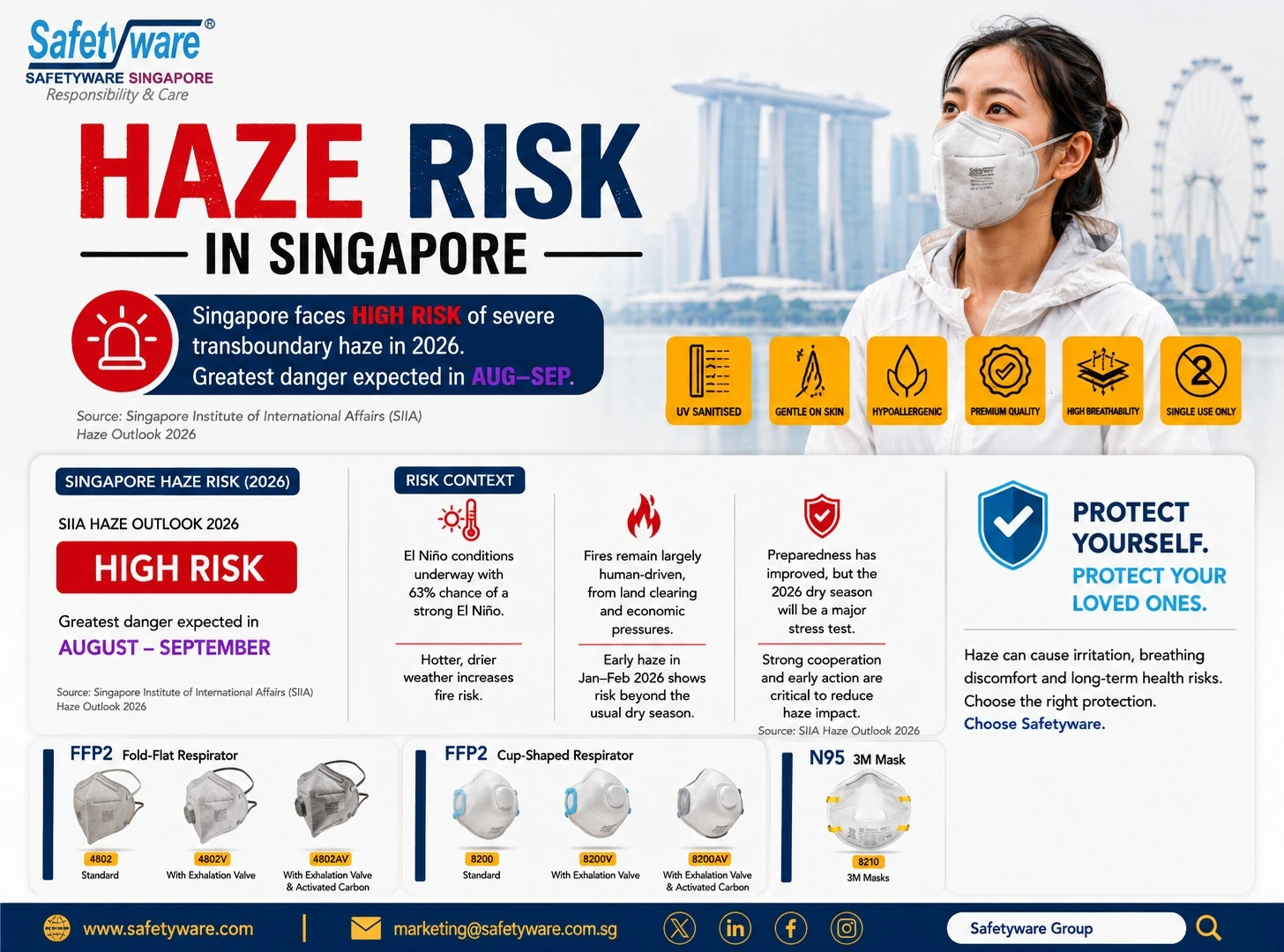
The Singapore Institute of International Affairs has rated the regional haze risk “Red” for 2026. This rating indicates a high risk of a severe transboundary haze event.
Moreover, the institute identifies August and September as the most concerning months. Hotter weather, dry conditions, land fires, and changing winds could increase Singapore’s exposure.
However, a high-risk rating does not guarantee severe haze. Rainfall, wind direction, regional fire control, and land-management efforts will influence the actual conditions.
Nevertheless, early preparation remains important. Families can reduce exposure, while employers can protect outdoor workers and maintain business continuity.
This guide explains the haze risk in Singapore in 2026. It also covers PSI readings, health effects, respirator selection, household preparation, and workplace safety.
What Is the Haze Risk in Singapore in 2026?
The haze risk in Singapore in 2026 is high, according to the SIIA Haze Outlook 2026.
In fact, this is only the second Red rating since the institute launched its annual Haze Outlook in 2019. The previous Red rating appeared in 2023.
The outlook covers Singapore, Indonesia, Malaysia, and Brunei. It highlights weather, economic, policy, and land-management factors that may increase the risk of regional fires.
Most importantly, the outlook identifies August and September as the peak danger period. Therefore, organisations should complete their haze preparations before this period.
Still, people should treat the outlook as a risk assessment, not a weather forecast. Official air-quality readings remain the best guide for daily decisions.
For current conditions, check Singapore’s National Environment Agency website, haze portal, or myENV application. These channels publish PSI readings, PM2.5 data, forecasts, and advisories.
Why Could Singapore Experience Severe Haze?
Singapore’s transboundary haze usually comes from smoke produced by land and forest fires in the region.
When conditions become hot and dry, vegetation and peatlands can catch fire more easily. Subsequently, these fires may burn longer and become harder to control.
Meanwhile, prevailing winds can carry smoke towards Singapore. As a result, local air quality can deteriorate even when no major fires occur within Singapore.
Several factors could raise the haze risk during 2026.
Hotter and drier weather
First, possible El Niño conditions could bring hotter and drier weather to parts of Southeast Asia.
In addition, a positive Indian Ocean Dipole could intensify dry conditions. Together, these weather patterns may increase the likelihood and severity of regional fires.
However, weather conditions can change throughout the season. Therefore, businesses and households should follow current forecasts instead of relying only on annual projections.
Land and forest fires
Second, human activity continues to cause many regional fires. For example, some landowners use fire to clear vegetation for agriculture.
Dry conditions can quickly turn a controlled fire into a widespread incident. Peat fires cause particular concern because they can burn underground and release dense smoke.
Furthermore, economic pressures and agricultural demand may increase land-use pressures. Effective enforcement and sustainable land management will therefore remain essential.
Wind direction and low rainfall
Finally, smoke must travel towards Singapore before it affects local air quality.
Wind direction determines where the smoke moves. Meanwhile, rainfall can suppress fires and remove particles from the atmosphere.
Consequently, Singapore may experience clear conditions even when regional hotspots increase. Conversely, a change in wind direction can cause conditions to worsen quickly.
How Does Haze Affect Your Health?
Fine particulate matter, known as PM2.5, creates the main health concern during haze episodes.
These particles measure 2.5 micrometres or smaller. Because of their small size, they can travel deep into the respiratory system.
Short-term haze exposure may cause:
- Irritated eyes, nose, or throat
- Coughing and wheezing
- Headaches or fatigue
- Chest discomfort
- Shortness of breath
- Worsening asthma symptoms
- Aggravation of existing heart or lung conditions
Healthy people may experience temporary irritation after short-term exposure. However, individual reactions can vary considerably.
Children, older adults, and pregnant women may face greater sensitivity. Moreover, people with asthma, chronic lung disease, or heart disease should take additional precautions.
Anyone who develops breathing difficulties should seek medical advice. Likewise, people with existing medical conditions should keep their prescribed medication readily available.
How Should You Read Singapore’s PSI Levels?
Singapore uses the 24-hour Pollutant Standards Index to describe air quality and guide health precautions.
| 24-Hour PSI | Air-Quality Category | General Guidance |
|---|
| 🔵 0–50 | 🔵 Good | Continue normal activities. |
| 🟢 51–100 | 🟢 Moderate | Continue normal activities. |
| 🟡 101–200 | 🟡 Unhealthy | Reduce prolonged or strenuous outdoor physical exertion. |
| 🟠 201–300 | 🟠 Very Unhealthy | Avoid prolonged or strenuous outdoor physical exertion. |
| 🔴 Above 300 | 🔴 Hazardous | Minimise outdoor activity. |
NEA also publishes one-hour PM2.5 readings for five Singapore regions. These readings help people understand immediate changes in particle concentrations.
However, hourly PM2.5 readings can fluctuate throughout the day. Therefore, use the 24-hour PSI and official health advisory when planning prolonged outdoor activities.
Additionally, check the readings for your location. Air quality may differ between Singapore’s North, South, East, West, and Central regions.
How Can Families Prepare for Singapore Haze?
Early preparation helps families respond calmly when air quality worsens. It also reduces the need for rushed purchases during a haze episode.
Monitor official updates
First, follow NEA updates through its website, the haze portal, or the myENV application.
Check the PSI before exercising, travelling, or planning outdoor events. Furthermore, review official forecasts because they can provide advance notice of deteriorating conditions.
Do not judge air quality through visibility or smell alone. Fine particles may still reach unhealthy concentrations when the air looks relatively clear.
Improve indoor air quality
Next, close windows and doors when outdoor air quality becomes poor.
Use a suitable air purifier if one is available. In addition, choose a purifier with an appropriate particle filter and enough capacity for the room.
Clean or replace its filters according to the manufacturer’s instructions. Otherwise, a clogged filter may reduce the purifier’s effectiveness.
Moreover, avoid creating extra indoor pollution. For example, reduce smoking, incense burning, and other activities that release particles.
Adjust outdoor activities
When the PSI reaches unhealthy levels, reduce prolonged or strenuous outdoor exercise.
Instead, move activities indoors or schedule them when air quality improves. Additionally, take more breaks if outdoor activity remains necessary.
Vulnerable individuals should follow stricter precautions. Most importantly, refer to the latest Ministry of Health guidance for advice based on health status.
Keep essential items available
Families should keep drinking water, medication, and appropriate respirators available.
However, avoid unnecessary stockpiling. A reasonable supply helps the household prepare without creating shortages for other people.
Do You Need an N95 or FFP2 Respirator?
Most healthy people do not need an N95 respirator for short journeys, such as travelling between home and work.
Likewise, people generally do not need respirators in clean indoor environments. Reducing outdoor exposure often provides a simpler and more comfortable control measure.
However, a certified particulate respirator can reduce exposure when a person must remain outdoors during severe haze.
The Ministry of Health advises healthy individuals to consider a well-fitted N95 during prolonged outdoor exposure when the PSI exceeds 300.
Older adults and pregnant women should consult a doctor before extended respirator use. People with severe heart or lung conditions should do the same.
Respirators increase breathing resistance. Therefore, medical advice may help vulnerable users choose an appropriate protection strategy.
How to Choose Suitable Respiratory Protection
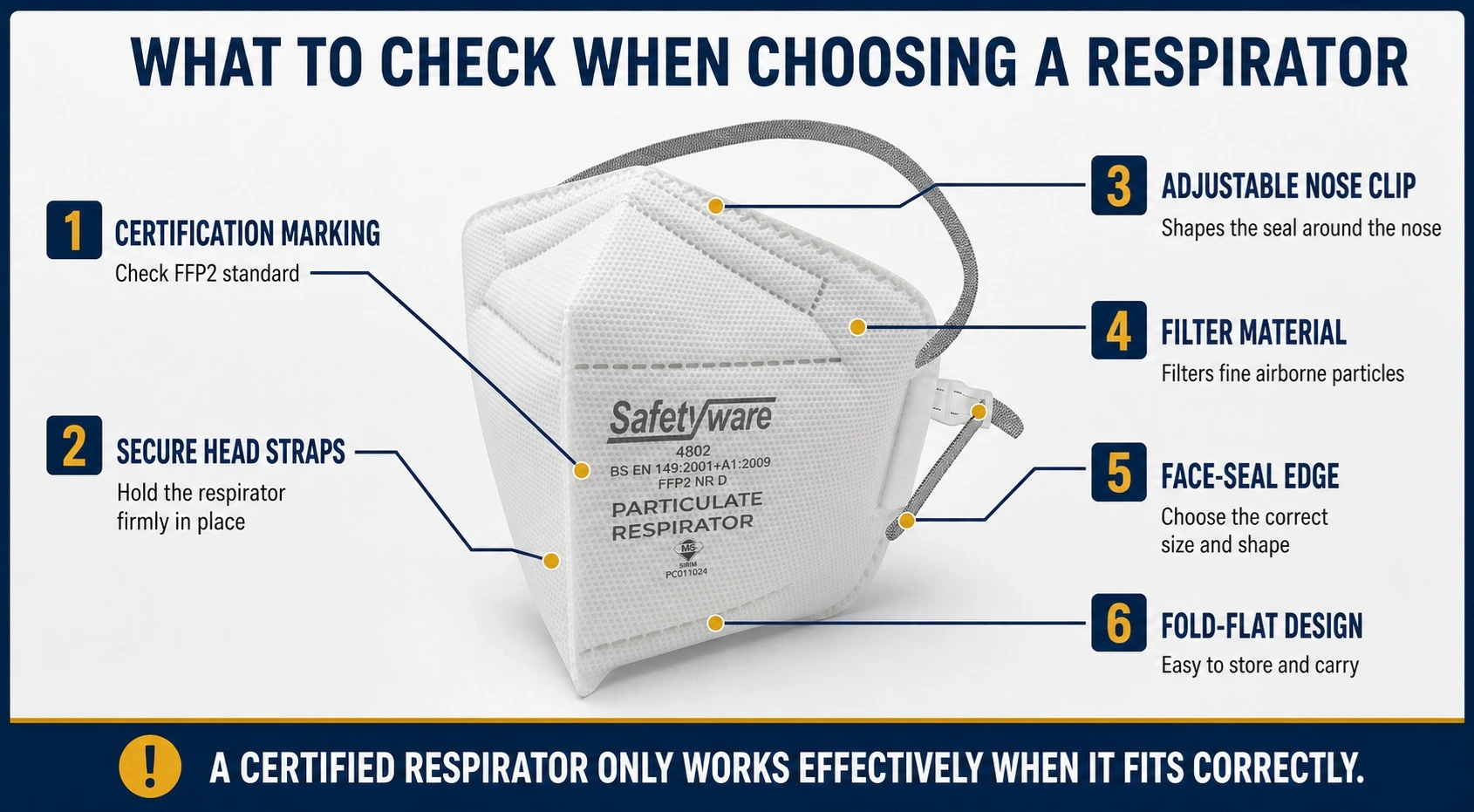
Choose a respirator that meets a recognised standard, such as N95 or FFP2.
Next, check the product markings, instructions, manufacturer, and certification details. Avoid products with unclear origins or unsupported protection claims.
A suitable respirator should:
- Cover the nose, mouth, and chin
- Form a close seal against the face
- Remain secure during movement
- Feel comfortable for its intended wearing period
- Show clear certification and usage information
- Match the hazards identified through a risk assessment
Fit remains essential because air can enter through gaps around the face. Therefore, adjust the nose clip and straps carefully.
Furthermore, facial hair around the sealing surface can reduce protection. Users should always perform the fit check described in the product instructions.
Replace a disposable respirator when it becomes wet, dirty, damaged, or difficult to breathe through. Additionally, never share a used disposable respirator.
Surgical and ordinary cloth masks do not provide equivalent filtration and fit. Consequently, they should not replace certified respirators when particulate protection becomes necessary.
Workplace Haze Safety for Singapore Employers
Employers should establish a haze-response plan before air quality enters the unhealthy range.
First, identify employees who perform prolonged or strenuous outdoor work. Then, assess how haze could affect their tasks, health, and emergency arrangements.
A practical workplace plan should include:
- Regular monitoring of PSI readings and forecasts
- Clear triggers for reducing outdoor activities
- Rescheduling of strenuous tasks where possible
- More frequent rest breaks
- Access to drinking water and clean rest areas
- Suitable respiratory protection when required
- Training on correct respirator fitting and use
- Procedures for reporting symptoms
- Additional protection for vulnerable workers
- Communication with employees and contractors
Where possible, employers should use administrative controls before relying on respirators. For example, they can shorten outdoor shifts or move work into enclosed areas.
Nevertheless, some operations must continue outdoors. In those situations, employers should select suitable respirators through a proper workplace risk assessment.
Protect Your Family and Workforce with Safetyware
Safetyware Singapore offers respiratory protection for personal and workplace haze preparation.
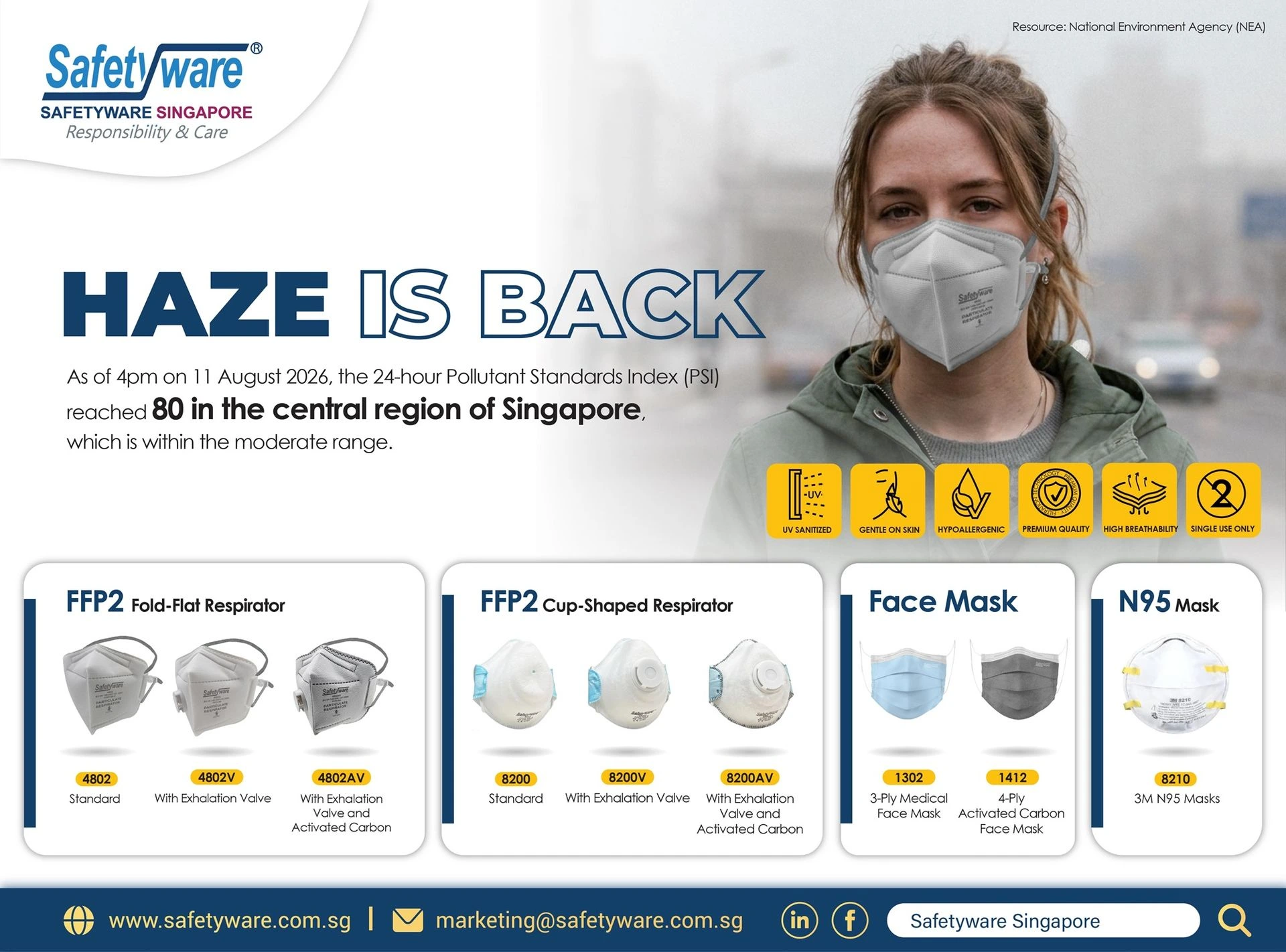
Available options include fold-flat FFP2 respirators, cup-shaped FFP2 respirators, valved models, and selected N95 masks. Different designs support various facial profiles, tasks, and workplace requirements.
However, the correct choice depends on the user, exposure conditions, task, and required protection level. Therefore, professional product guidance can simplify the selection process.
For product recommendations, availability, or bulk orders, contact our sales team:
Prepare early, choose suitable protection, and ensure users understand correct fitting procedures.
Frequently asked questions about Singapore Haze
No. The Red rating indicates a high risk, but it does not guarantee severe haze. Weather, rainfall, fires, and wind direction will determine actual conditions.
The SIIA identifies August and September 2026 as the period of greatest concern. However, Singapore can experience haze outside this period.
Singapore classifies a 24-hour PSI from 101 to 200 as unhealthy. A reading above 300 falls within the hazardous category.
No. Healthy people usually do not need N95 masks for short journeys. Consider one for prolonged outdoor exposure during hazardous conditions and follow current MOH advice.
Surgical masks do not offer the same filtration and facial seal as certified N95 or FFP2 respirators. Therefore, they provide limited protection against fine haze particles.
Standard adult respirators may not fit children correctly. Parents should reduce children’s outdoor exposure and follow advice from Singapore’s health authorities.
Follow the manufacturer’s instructions. Replace the respirator when it becomes dirty, wet, damaged, distorted, or difficult to breathe through.
Check the NEA website, Singapore’s haze portal, or the myENV application. These sources provide PSI readings, hourly PM2.5 data, forecasts, and health advisories.
Prepare Now for the 2026 Haze Season
The haze risk in Singapore in 2026 deserves serious attention, particularly before August and September.
However, preparation does not require panic. Instead, follow official updates, improve indoor air quality, adjust outdoor activity, and keep essential medication accessible.
Moreover, choose certified respiratory protection when conditions and activities require it. A suitable respirator must fit correctly to provide meaningful protection.
Finally, businesses should prepare their workers, procedures, and protective equipment early. Timely action can reduce health risks and support safer operations throughout the haze season.
For respiratory protection guidance or bulk-order assistance, contact the Safetyware Singapore sales team using the details above.
Disclaimer: This article provides general information only. Always follow the latest guidance from Singapore’s NEA, Ministry of Health, and Ministry of Manpower.