跳至内容

Essential PPE for the Oil, Gas & Petrochemicals in Singapore

A practical guide to reliable protection for high-risk process environments
2026年8月15日
Essential PPE for the Oil, Gas & Petrochemicals in Singapore
SAFETYWARE (SG) PTE LTD
Singapore’s oil, gas and petrochemical industries support global trade. However, workers often operate near chemicals, flammable materials, pressurised systems and heavy equipment.

Therefore, employers need a planned PPE programme. The right PPE reduces exposure when stronger controls cannot remove every remaining risk.

However, no single PPE set suits every employee or activity. Instead, companies should match each item to the task, work area, chemical and expected exposure.

This guide helps safety teams choose PPE for process plants and maintenance projects.

Why is PPE essential in process-industry workplaces?


Incidents can involve fires, explosions, chemical splashes, toxic releases or falling objects. In addition, routine work can expose employees to noise, heat and slippery floors.

PPE provides the final barrier between a worker and these hazards. Nevertheless, employers should never use PPE as the only control.

First, safety teams should eliminate hazards where reasonably practicable. Next, they should consider substitution, engineering controls, safe procedures and permit-to-work systems.

Finally, teams should provide suitable PPE for the risks that remain. Singapore’s WSH Risk Management Regulations include PPE within the hierarchy of controls.

Additionally, MOM’s risk management guidance covers risk identification, assessment, control, monitoring and communication.

What PPE do oil and gas workers need?

Most facilities set baseline PPE rules. However, final requirements should follow the task-specific risk assessment.

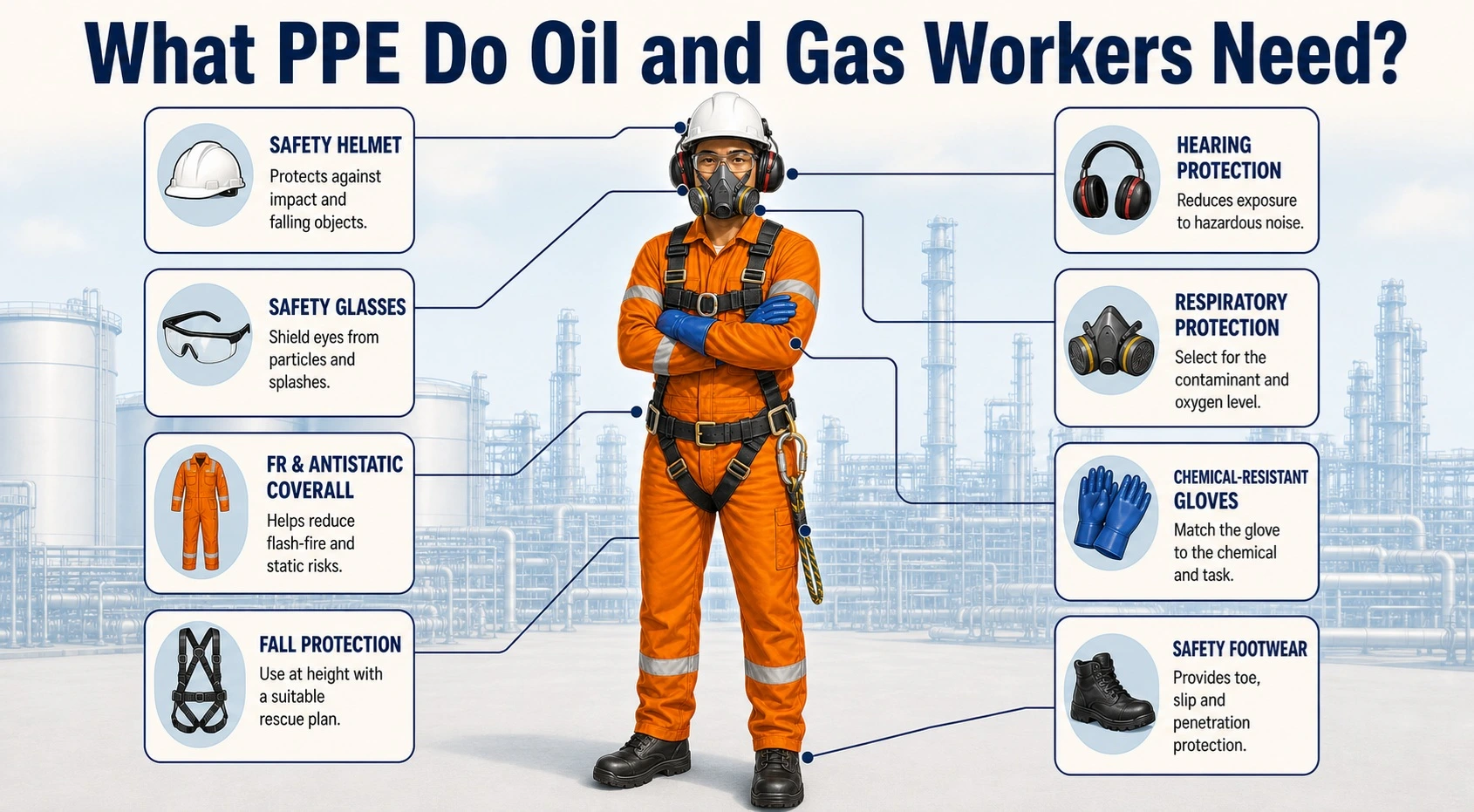
Common PPE includes:
- Safety helmets
- Safety glasses, chemical goggles and face shields
- Flame-resistant and antistatic clothing
- Chemical-resistant and task-specific gloves
- Protective safety footwear
- Hearing protection
- Respiratory protective equipment
- Fall-protection equipment
- High-visibility clothing
- Chemical suits and emergency breathing equipment

Additionally, sampling, line breaking, tank cleaning, hot work and emergency response may require extra protection.
1. Flame-resistant and antistatic clothing
Flammable gases and vapours can create flash-fire risks. Therefore, workers may need flame-resistant clothing that limits flame spread and helps reduce burn injuries.

Additionally, antistatic properties may help control ignition risks in certain hazardous areas. However, flame resistance and antistatic performance address different hazards.

Consequently, buyers should confirm that each garment meets the site’s exact requirements. Standards such as NFPA 2112, ISO 11612 and EN 1149 may support product selection.

Moreover, buyers should check coverage, closures and PPE compatibility. They should also consider heat burden in Singapore’s climate.

Finally, workers must inspect clothing before use. They should remove torn, damaged or chemically contaminated garments from service immediately.

2. Head, eye and face protection
Safety helmets protect against falling objects, overhead structures and impacts. Therefore, check each helmet’s rating, suspension, retention system and compatibility with approved accessories.

Meanwhile, safety spectacles protect against general impact. Chemical goggles provide stronger splash protection, while face shields add coverage during chemical transfer, grinding or high-heat work.

However, a face shield normally supplements glasses or goggles. Additionally, welding requires a suitable helmet and filter shade.

 3. Task-specific hand protection
No glove material protects against every petrochemical hazard. Therefore, glove selection must begin with the exact chemical, physical hazard and contact duration.

For example, chemical-resistant gloves address selected substances. In contrast, cut-resistant, impact-resistant and heat-resistant gloves address specific mechanical or thermal risks.

For chemical work, review Section 8 of the safety data sheet. Additionally, check the manufacturer’s permeation, breakthrough and degradation data for the specific substance.

Because temperature and concentration affect performance, never select gloves by material name alone. Finally, plan safe removal and disposal.

4. Protective safety footwear / safety shoes
Process areas can contain wet floors, sharp objects, hot surfaces and heavy equipment. Consequently, suitable footwear may need several protective features.

Features can include toe protection, penetration resistance, slip resistance and fuel-oil resistance. Furthermore, some tasks require heat-resistant soles or specific electrical properties.

However, antistatic footwear and electrical-hazard footwear serve different purposes. Therefore, safety teams should select electrical properties according to the site assessment.

Moreover, a secure, comfortable fit improves stability during long shifts.

5. Hearing protection
Compressors, turbines, pumps and maintenance tools can produce hazardous noise. Therefore, companies should measure workplace and personal noise exposure before choosing protection.

Singapore’s WSH Noise Regulations include an 85 dB(A) eight-hour limit for fluctuating noise.

After monitoring, employers can select suitable earplugs, earmuffs or dual protection. However, excessive attenuation can make alarms, radios and approaching vehicles harder to hear.

Therefore, teams should balance protection with communication. Additionally, training should cover fitting, cleaning, storage and replacement.

6. Respiratory protective equipment
Process workers may encounter toxic gases, hydrocarbon vapours, acid gases, fumes or hazardous particles. Consequently, safety teams must identify the contaminant before selecting a respirator.

An N95 respirator filters selected particles. However, it does not protect against chemical gases, vapours or oxygen deficiency.

Instead, employers should consider contaminant type, concentration, oxygen level, exposure limit, work duration and emergency conditions.

Singapore Standard SS 548:2022 covers respirator selection, use and maintenance. Additionally, tight-fitting respirators require fit testing.

Air-purifying respirators require the correct cartridge. In contrast, oxygen-deficient or unknown atmospheres may require supplied air or self-contained breathing apparatus.


7. Fall protection for work at height
Workers may access tanks, pipe racks, platforms and elevated structures. Therefore, employers should prioritise permanent access, guardrails and other collective controls.

When personal protection remains necessary, the system may include a full-body harness, lanyard, connector and approved anchorage.

However, equipment alone cannot ensure survival after a fall. Consequently, teams must calculate clearance, prevent swing falls and prepare a prompt rescue plan.

Moreover, competent personnel should inspect the system and verify component compatibility. See the WSH Council’s work-at-height guidance.

8. PPE for confined spaces and chemical emergencies
Tanks, vessels and pits may contain flammable gases, toxic substances or oxygen-deficient atmospheres. Therefore, workers must never rely on PPE alone for confined-space entry.

First, isolate the space and complete the entry permit. Next, test the atmosphere and establish ventilation, communication and rescue arrangements.

Additionally, entrants may need protective clothing, gloves, footwear, a harness, respiratory protection and a personal gas detector.

For chemical emergencies, trained responders may need chemical suits and breathing apparatus. Furthermore, the emergency plan should address decontamination and medical support.

Additionally, the WSH Council explains key controls in its confined-space guidance.

How to choose petrochemical PPE in Singapore

Follow these practical steps:
1. Define the task. Include normal work, cleaning, maintenance and emergencies.
2. Identify every hazard. Review the process, SDS, monitoring and incidents.
3. Apply stronger controls first. Consider elimination, isolation, ventilation and safe procedures.
4. Describe residual exposure. Record the substance, concentration, temperature, noise and duration.
5. Specify PPE performance. Select suitable standards, protection levels and materials.
6. Test the ensemble. Check fit, movement, vision, communication and compatibility.
7. Train every wearer. Cover use, limitations, removal, cleaning and storage.
8. Review performance. Reassess PPE after incidents or process changes.

Moreover, companies should involve workers during trials. Their feedback can reveal problems involving grip, fogging, movement, heat and communication.

Essential PPE by hazard and activity

The following table offers a practical starting point. However, it does not replace a competent, site-specific assessment.

Hazard or activity

PPE to consider

Main selection points

Routine process-area work

Safety helmet, safety eyewear, FR clothing, gloves and safety footwear

Site rules, ignition hazards, fit and compatibility

Sampling and chemical transfer

Chemical-resistant gloves and clothing, goggles, face shield and suitable footwear

Chemical identity, concentration, permeation and splash direction

Flash-fire exposure

Tested flame-resistant clothing and compatible accessories

Hazard analysis, garment system, coverage and condition

Toxic gases, vapours or particles

Selected respirator, escape device or supplied-air system

Contaminant, concentration, oxygen level and required protection factor

High-noise equipment

Earplugs, earmuffs or assessed dual protection

Exposure monitoring, required attenuation and communication needs

Work at height

Full-body harness, connectors and suitable anchorage or lifeline

Fall clearance, swing fall, inspection and rescue planning

Confined-space entry

Task PPE, gas detector, respiratory protection and retrieval equipment

Isolation, atmosphere, monitoring, entry permit and rescue plan

Welding, cutting or grinding

Eye and face protection, gloves, FR clothing and hearing protection

Radiation, sparks, hot metal, fumes and nearby process hazards

Chemical emergency response

Chemical protective ensemble, compatible gloves, boots and breathing apparatus

Chemical compatibility, decontamination and responder competence

Different phases of one job may require different equipment. Therefore, supervisors should review preparation, execution, cleanup and foreseeable emergency conditions separately.

Chemical protective clothing requires precise selection

A disposable coverall does not automatically qualify as a chemical protective suit. Instead, buyers must identify the exposure form and required coverage.

Chemical exposure can involve dry particles, light spray, liquid splash, pressurised jets, vapour or gas. Consequently, each condition demands different material, seam and closure performance.

Standards such as EN 13034, EN 14605, EN ISO 13982-1 and EN 943 distinguish protective clothing types. However, the type number alone does not indicate overall superiority.

For example, one suit may resist particles but offer limited liquid protection. Another may resist spray yet lack the gas-tight construction needed for a specific emergency.

Therefore, buyers should ask these questions:
- Which chemical or mixture could contact the worker?
- What concentration and temperature should the suit withstand?
- Will exposure involve particles, spray, splash, jet, vapour or gas?
- Which body areas need protection?
- How long could contact continue?
- What permeation and physical durability data support the choice?
- Do the seams and closures provide suitable performance?
- Will the suit connect safely with gloves, boots and respiratory equipment?
- How will workers remove and decontaminate the ensemble?

Additionally, teams should distinguish reusable equipment from limited-use and disposable products. Each category needs clear inspection, cleaning, storage and retirement rules.

PPE compatibility can determine real protection

Individual products can meet recognised standards and still perform poorly together. Therefore, safety teams should assess the complete ensemble rather than approve each item independently.

Common compatibility problems include:
- Spectacle arms breaking the seal of earmuffs
- Goggles lifting the edge of a tight-fitting respirator
- Face shields striking respirator filters or cartridges
- Gloves leaving an exposed gap at the sleeve
- Harness straps obstructing garment closures
- Overshoes reducing traction on wet surfaces
- Helmet accessories affecting balance or retention
- Hearing protection interfering with radios or alarms

Furthermore, workers should test the ensemble while performing realistic movements. These movements may include climbing, crouching, reaching, turning valves and using tools.

Teams should include workers with different body sizes and facial characteristics. Moreover, they should document approved combinations to prevent uncontrolled substitutions.

Managing heat stress while wearing industrial PPE


Singapore’s heat and humidity can increase the physical burden of PPE. Additionally, FR coveralls, chemical suits and respirators can trap heat and reduce evaporative cooling.

However, teams should not remove required protection simply to improve comfort. Instead, they should control heat stress through planning and supervision.

Useful measures can include:
- Scheduling demanding work during cooler periods
- Providing shaded or cooled recovery areas
- Establishing suitable work and rest periods
- Supplying accessible drinking water
- Allowing workers to acclimatise gradually
- Rotating demanding tasks where practical
- Monitoring workers for early symptoms
- Selecting lighter certified equipment when protection remains equivalent

Supervisors should understand symptoms such as dizziness, headache, confusion, weakness and unusual fatigue. Consequently, they can stop work and start the site response before the condition worsens.

Moreover, teams should consider how respirators affect breathing resistance and communication. Chemical suits may also limit vision, dexterity and movement.

Therefore, trials should reproduce the expected workload and environmental conditions. A comfortable fitting-room trial cannot reveal every problem that appears during field work.

PPE for common refinery and petrochemical tasks


Routine plant inspection
Routine inspection often requires baseline site PPE. Typically, this includes a helmet, eye protection, FR clothing, gloves and suitable safety footwear.

However, inspectors may enter designated high-noise or chemical areas. Therefore, they should carry or wear any additional protection specified by signage and procedures.

Sampling and laboratory transfer
Sampling can release liquid, vapour or pressure unexpectedly. Consequently, the procedure should control pressure and position the worker away from the likely release path.

Goggles, a face shield, chemical gloves and protective clothing may support the task. Nevertheless, the process design and sampling method provide the primary control.

Line breaking and equipment opening
Residual pressure or trapped chemicals can create serious exposure. First, teams should isolate, drain, depressurise, purge and verify the equipment.

Next, they should select splash, respiratory and body protection for the remaining risk. Additionally, workers should position themselves away from the initial opening path.

Shutdown and turnaround maintenance
Shutdowns involve many contractors, simultaneous tasks and changing conditions. Therefore, site coordination, permit controls and PPE communication become especially important.

Workers may encounter grinding, welding, lifting, chemicals, noise and work at height during one shift. Consequently, supervisors should review interfaces between crews and activities.

Tank and vessel cleaning
Cleaning may combine confined-space, chemical, biological and physical hazards. Therefore, entry controls must address isolation, ventilation, atmospheric monitoring, communication and rescue.

PPE may include a chemical ensemble, respiratory equipment, gloves, boots and fall or retrieval equipment. However, the assessment must define each item and its limitations.

Build a complete respiratory protection programme

Purchasing respirators alone does not create reliable protection. Instead, companies need a managed programme covering selection, wearer suitability, fit, use, maintenance and evaluation.

The programme should identify approved respirator models for each task. Additionally, it should define cartridge change schedules and equipment inspection criteria.

Workers should understand the difference between particulate filters and gas or vapour cartridges. Moreover, they should know when an air-purifying respirator cannot provide adequate protection.

Unknown concentrations and oxygen-deficient atmospheres require special caution. Consequently, only competent personnel should decide whether supplied-air equipment or self-contained breathing apparatus can support the work.

Tight-fitting facepieces require fit testing with the exact model and size. Furthermore, wearers should complete a seal check whenever they put on the equipment.

Teams must also control facial hair and anything else that crosses the sealing surface. Examples include certain spectacle frames, head coverings and misplaced garment hoods.

After use, workers should clean, inspect and store reusable equipment correctly. Therefore, storage areas should protect respirators from contamination, deformation, sunlight and excessive humidity.

Establish clear inspection and replacement rules

PPE can deteriorate through use, storage, contamination, heat, sunlight and cleaning. Therefore, every programme needs defined pre-use and periodic inspections.

Before work starts, users should check:
- Whether the equipment matches the task and permit
- Whether the size and fit remain correct
- Whether cracks, cuts, holes or worn parts are visible
- Whether chemical contamination affects the material
- Whether labels and certification markings remain legible
- Whether filters and limited-life components remain within service periods
- Whether all ensemble components connect without gaps
- Whether emergency and replacement equipment remains ready

Workers should immediately remove defective PPE from service. Additionally, the company should prevent anyone from accidentally reissuing it.

Replacement frequency depends on product instructions, exposure, inspection results and site rules. Therefore, a universal replacement timetable cannot cover every product or condition.

Some respirator cartridges require a documented change schedule. Consequently, wearers should never rely only on smell, taste or discomfort as replacement warnings.

Improve contractor PPE management

Contractors frequently perform maintenance, inspection and project work in process facilities. Therefore, principals, occupiers and employers should clearly define PPE responsibilities before mobilisation.

Tender and purchase documents should describe performance requirements rather than vague labels. For example, “chemical glove” provides insufficient information without the relevant substance and exposure details.

Site induction should explain baseline PPE, restricted equipment and task-specific additions. Additionally, contractors should understand inspection, replacement and incident-reporting procedures.

Supervisors should verify actual equipment before work begins. Moreover, they should address incompatible or unapproved substitutions through the site’s change process.

The permit-to-work briefing provides another opportunity to confirm PPE. However, the permit should reflect the risk assessment rather than replace it.

Procurement questions for safety teams

Before approving any oil refinery safety equipment, ask the supplier for clear supporting information. Useful questions include:
- Which standard and protection level does the product meet?
- Can the supplier provide valid certification and test information?
- Does the product protect against the site’s exact hazard?
- What limitations does the manufacturer identify?
- Which sizes support the workforce?
- Can workers trial the product before a larger purchase?
- Which accessories have approval for use with it?
- How should users clean and store it?
- What replacement parts can the supplier provide?
- What lead time applies to repeat orders?

Additionally, consider the total cost of use rather than the purchase price alone. Poor fit, short service life or difficult maintenance can increase long-term costs.

Reliable stock management also matters. Therefore, companies should maintain suitable sizes, critical replacement parts and emergency quantities without keeping products beyond their storage life.

Create a PPE matrix for each work area

A PPE matrix helps workers and supervisors understand baseline and task-specific requirements. However, the matrix should remain simple enough for daily use.

Organise the matrix by area, activity or job role. Then, link each requirement to the relevant risk assessment, procedure or permit.

Useful matrix fields include:
- Work area or activity
- Main hazards
- Baseline PPE
- Additional task PPE
- Required standard or performance level
- Inspection frequency
- Replacement criteria
- Training or fit-testing needs
- Responsible department

Furthermore, teams should review the matrix after chemical, process or equipment changes. They should also update it after incidents, near misses or worker feedback.

Support PPE with training and supervision

Even suitable equipment can fail when workers use it incorrectly. Therefore, training should explain each product’s purpose, limitations and correct wearing method.

Practical demonstrations often work better than classroom explanations alone. For example, workers can practise adjusting helmets, fitting earplugs, checking respirator seals and removing contaminated gloves.

Moreover, supervisors should observe PPE use during real tasks. They can then correct loose straps, exposed skin, damaged equipment or unsafe removal methods immediately.

Training records should identify the worker, equipment, date and instructor. Additionally, companies should repeat training after product changes or evidence of incorrect use.

Workers also need a simple process for reporting discomfort and defects. Consequently, safety teams can investigate problems before employees stop wearing essential protection.

Finally, positive supervision should reinforce consistent behaviour. PPE becomes more effective when leaders follow the same site rules and act promptly on worker feedback.

Speak with our Singapore sales team

Choosing process-industry PPE requires careful evaluation. Therefore, expert guidance can help you compare materials, standards and protection levels.

Safetyware supplies equipment for operations, chemical handling, maintenance and shutdowns. Moreover, our team can help identify suitable options.

Contact our sales team:

Contact us today to discuss your hazards, work activities and PPE requirements.


Frequently asked questions

Workers commonly wear safety helmets, safety glasses, protective clothing, gloves and safety shoes. Additionally, certain tasks require hearing, respiratory, chemical or fall protection.

Workers need FR clothing when the risk assessment identifies a credible flash-fire or thermal hazard. However, the selected garment must match the site’s exposure and requirements.

No. An N95 filters selected particles, not chemical gases. Therefore, qualified personnel must select equipment according to gas concentration, oxygen level and emergency conditions.

No single glove suits every chemical. Instead, compare manufacturer permeation and degradation data with the exact chemical, concentration, temperature and expected contact time.

Workers should inspect PPE before each use. Additionally, the company should schedule detailed inspections according to manufacturer instructions, legal requirements and site procedures.

No. Employers should prioritise elimination, substitution and engineering controls. Afterwards, suitable PPE should address the remaining risk as the final protective barrier.

Strengthen your process-industry PPE programme

Effective PPE selection starts with a detailed risk assessment, not a generic shopping list. Therefore, every product should match the worker, task, environment and expected exposure.

Moreover, training, inspection and timely replacement keep protection effective. When businesses manage these elements together, they can support safer and more confident operations.

Contact Safetyware’s Singapore sales team today to find suitable PPE for your oil, gas or petrochemical workplace.

Disclaimer: This article provides general information, not legal or site-specific safety advice. Always follow current Singapore legislation, applicable standards, SDS guidance, manufacturer instructions and a competent risk assessment.