Haze may return to Singapore as dry regional conditions increase the risk of smoke travelling across borders. Therefore, households and businesses should prepare before air quality worsens.
On 1 September 2026, Singapore’s National Environment Agency reported dense smoke haze over parts of Sumatra and Kalimantan. Moreover, dry weather may continue across much of the surrounding region.
Singapore may experience hazy conditions if regional fires intensify and prevailing winds carry smoke towards the island. However, this forecast describes a risk rather than a confirmed severe haze event.
NEA continues to monitor regional hotspots, wind patterns and Singapore’s air quality. Additionally, it will issue daily advisories if the 24-hour Pollutant Standards Index enters the Unhealthy range.
Fortunately, several simple precautions can reduce your exposure. These haze safety tips for Singapore will help protect your health, family and workplace.
What causes haze in Singapore?
Transboundary haze often comes from land and forest fires in the surrounding region. During dry periods, these fires can produce large amounts of smoke and airborne particles.
Meanwhile, changing wind patterns may carry the smoke towards Singapore. Low rainfall can also allow dry conditions and fires to continue longer.
PM2.5 remains one of the main pollutants of concern during a haze episode. These fine particles measure 2.5 micrometres or less.
Because of their small size, PM2.5 particles can travel deep into the respiratory system. As a result, they may irritate the eyes, nose, throat and lungs.
Short-term exposure may cause coughing, throat irritation, headaches or breathing discomfort. Furthermore, haze may aggravate existing asthma, heart disease and other respiratory conditions.
Who faces a higher risk during haze?
Haze can affect everyone. However, several groups may experience symptoms sooner or more severely.
These vulnerable groups include:
- Children
- Older adults
- Pregnant women
- People with asthma
- People with chronic lung conditions
- People with heart disease
- People who work or exercise outdoors
Therefore, vulnerable individuals should reduce exposure earlier when air quality deteriorates. They should also keep prescribed medication nearby and follow their doctor’s advice.
Understand Singapore’s PSI readings
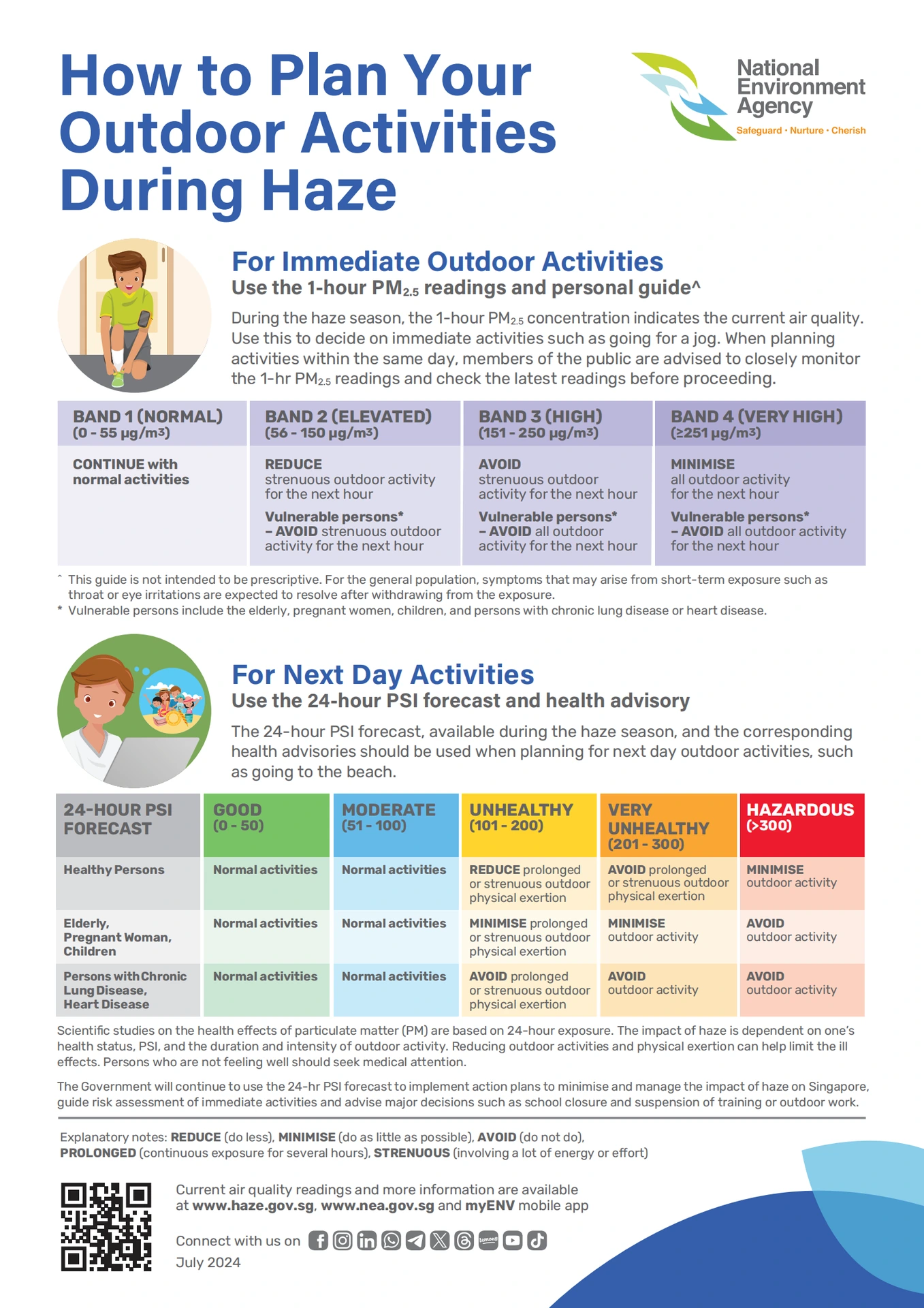
The Pollutant Standards Index, or PSI, measures Singapore’s air quality over a rolling 24-hour period. Therefore, it helps residents plan longer activities for the day ahead.
Singapore uses five PSI categories:
- 0–50: Good
- 51–100: Moderate
- 101–200: Unhealthy
- 201–300: Very Unhealthy
- Above 300: Hazardous
The one-hour PM2.5 reading serves a different purpose. Specifically, it shows recent fine-particle levels and supports immediate decisions.
For example, check the 24-hour PSI forecast when planning tomorrow’s outdoor event. Then, check the one-hour PM2.5 reading before leaving for a run.
Air quality can also differ across Singapore’s north, south, east, west and central regions. Therefore, check the reading for your location.
You can find current information through the NEA website, Singapore Haze Information Portal or myENV app.
Eight haze safety tips for Singapore residents
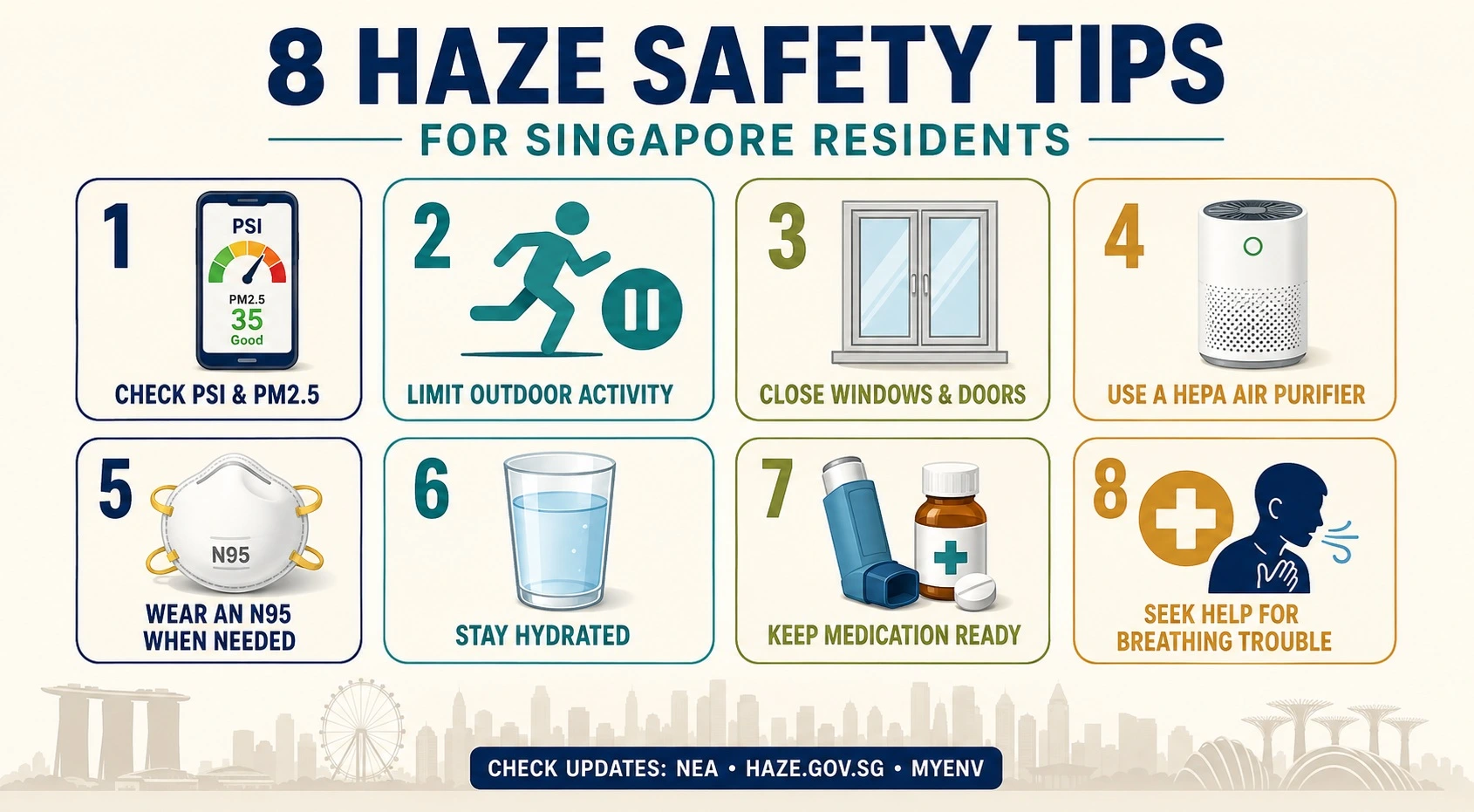
1. Reduce strenuous outdoor activity
First, reduce prolonged or strenuous outdoor exertion when the PSI enters the Unhealthy range. This includes running, cycling, intensive sports and physically demanding outdoor work.
Healthy people do not always need to remain indoors completely. However, they should shorten outdoor activities and lower their intensity.
Meanwhile, vulnerable individuals should take stricter precautions. People with chronic heart or lung conditions should avoid prolonged or strenuous outdoor exertion when the PSI exceeds 100.
2. Plan activities using official forecasts
Next, check the air quality before travelling, exercising or organising an outdoor event. Conditions may change quickly because of rainfall and wind direction.
Therefore, use the 24-hour PSI forecast for next-day planning. In contrast, use the one-hour PM2.5 reading for immediate outdoor decisions.
If readings rise, consider moving an event indoors. Alternatively, postpone the activity until air quality improves.
3. Keep windows and doors closed
When outdoor air quality worsens, close your windows and external doors. This action slows the movement of haze particles into your home.
However, reopen them when outdoor conditions improve. Fresh air can then ventilate the room and reduce indoor pollutants.
Additionally, check whether your air conditioner draws air from outside. If it does, close its external air intake during poor conditions.
A portable air purifier can further reduce indoor particle levels. NEA recommends highly efficient filters such as HEPA filters for fine particles. Choose a purifier suitable for the size of the room and, where available, compare its smoke Clean Air Delivery Rate.
These measures are especially helpful in bedrooms and rooms used by children, older adults or family members with respiratory conditions.
View NEA’s household haze recommendations.
4. Improve indoor air quality
Portable air purifiers can help reduce particle levels inside enclosed rooms. In particular, NEA recommends highly efficient filters, such as HEPA filters, for fine-particle removal.
However, choose a purifier that matches the room’s size. Also, review its smoke Clean Air Delivery Rate when that information appears on the label.
Place the purifier in a room where vulnerable family members spend the most time. Then, clean or replace its filter according to the manufacturer’s instructions.
Furthermore, avoid smoking or burning candles indoors. These activities add more particles to the air.
5. Use wet-cleaning methods
Haze particles can settle on floors, furniture and other surfaces. Therefore, remove them with a damp cloth or mop.
In contrast, dry dusting may stir particles into the air again. Consequently, sensitive individuals may experience additional irritation.
You can also wipe frequently touched surfaces and wash exposed bedding. However, avoid creating unnecessary dust while cleaning.
6. Know when an N95 mask or FFP2 mask may help
A properly fitted N95 mask can reduce exposure to fine airborne particles. However, an N95 mask does not replace reduced exposure.
Singapore’s Ministry of Health states that N95 masks remain unnecessary for short journeys. Examples include travelling from home to work or walking from a bus stop.
Likewise, people generally do not need N95 masks indoors. Nevertheless, a healthy adult may use one during prolonged outdoor exposure when the PSI exceeds 300.
The mask must fit closely around the nose, cheeks and chin. Otherwise, unfiltered air can enter through gaps.
Additionally, N95 masks increase breathing effort. Therefore, older adults, pregnant women and people with serious heart or lung conditions should seek medical advice before prolonged use.
Normal surgical masks do not filter PM2.5 as effectively as N95 masks. Consequently, choose respiratory protection according to official advice and your exposure level.
7. Stay hydrated and keep medication nearby
Haze and hot weather may cause throat dryness and general discomfort. Therefore, drink enough water throughout the day.
However, water cannot stop fine particles from entering your lungs. You must still reduce exposure when air quality worsens.
People with asthma or other chronic conditions should keep prescribed medication available. Additionally, they should check that inhalers remain usable and have not expired.
Most importantly, continue taking medication according to medical advice. Do not change your treatment plan without consulting a healthcare professional.
8. Watch for warning signs
Mild irritation often improves after a person moves away from polluted air. However, persistent or serious symptoms require medical attention.
Seek medical advice if you experience:
Shortness of breath
Wheezing
Chest pain or tightness
A persistent cough
Severe eye or throat irritation
Dizziness or unusual weakness
Worsening asthma symptoms
Furthermore, vulnerable individuals should seek help promptly when they feel unwell. Early medical advice may prevent symptoms from becoming more serious.
Haze protection for Singapore workplaces
Employers also play an important role during a haze episode. Therefore, they should monitor NEA forecasts and assess each employee’s exposure.
Outdoor workers may face longer exposure than the general public. Consequently, employers should consider job rotation, additional breaks and less strenuous work.
Where possible, teams should reschedule demanding outdoor tasks. Alternatively, they can move suitable work into an enclosed area with cleaner air.
Employers should also provide suitable respiratory protection when their risk assessment requires it. Additionally, workers need instructions on correct fitting, use and replacement.
Finally, supervisors should watch for breathing difficulties, fatigue or heat-related symptoms. Workers should report discomfort early and move to a safer area.
Prepare your haze protection supplies
Preparation helps households and businesses respond calmly when the PSI rises. Therefore, check your essential supplies before the haze arrives.
Consider preparing:
Suitable N95 masks or FFP2 mask
Replacement air-purifier filters
Prescribed respiratory medication
Damp-cleaning supplies
Access to official haze alerts
Drinking water for outdoor teams
However, avoid panic buying or unnecessary stockpiling. Instead, choose suitable products based on your needs, environment and likely exposure.
Need help selecting haze protection products?
Choosing suitable respiratory protection can feel confusing. Moreover, workplaces may need different solutions because employees face varying exposure levels.
Our sales team can help you explore suitable haze protection and workplace safety products. Additionally, the team can provide relevant product information for your requirements.
Contact our sales team:
Contact us early to prepare your home or workplace before air quality deteriorates.
Frequently asked questions
Singapore classifies a 24-hour PSI between 101 and 200 as Unhealthy. Therefore, residents should begin adjusting prolonged or strenuous outdoor activities when readings exceed 100.
No. MOH does not generally recommend an N95 mask for brief outdoor exposure or indoor use.
Instead, check the PSI, exposure duration and your health condition. A healthy adult may consider one during prolonged outdoor exposure when the PSI exceeds 300.
A normal surgical mask does not filter fine particles as effectively as a properly fitted N95 mask. Therefore, it should not replace suitable respiratory protection when protection becomes necessary.
Yes, close windows and external doors when outdoor air quality worsens. However, reopen them for ventilation after conditions improve.
Healthy individuals should reduce prolonged or strenuous outdoor exercise in the Unhealthy range. Meanwhile, vulnerable people should take stronger precautions or choose an indoor activity.
They should reduce exposure, follow their treatment plan and keep prescribed medication nearby. Additionally, they should seek medical advice if wheezing or breathing difficulties worsen.
Check the NEA website, Haze Information Portal or myENV app. These official channels provide regional PSI readings, one-hour PM2.5 information and health advisories.
Stay informed and prepare early
Haze conditions can change quickly. Therefore, preparation and reliable information remain your strongest first steps.
Check official updates, reduce unnecessary exposure and protect vulnerable family members. Finally, contact our sales team if you need help choosing suitable haze protection products.
This article provides general safety information. It does not replace medical advice, an occupational risk assessment or instructions from Singapore authorities.